A citywide experiment testing the impact of geographically targeted, high-pay-off vaccine lotteries
"We implemented a pre-registered, citywide experiment to test the effects of three high-pay-off, geographically targeted lotteries designed to motivate adult Philadelphians to get their COVID-19 vaccine...we do not detect evidence of any overall benefits."
Lotteries have been shown to motivate behaviour change in many settings, but their value as a policy tool is relatively untested. We implemented a pre-registered, citywide experiment to test the effects of three high-pay-off, geographically targeted lotteries designed to motivate adult Philadelphians to get their COVID-19 vaccine. In each drawing, the residents of a randomly selected ‘treatment’ zip code received half the lottery prizes, boosting their chances of winning to 50×–100× those of other Philadelphians. The first treated zip code, which drew considerable media attention, may have experienced a small bump in vaccinations compared with the control zip codes: average weekly vaccinations rose by an estimated 61 per 100,000 people per week (+11%). After pooling the results from all three zip codes treated during our six-week experiment, however, we do not detect evidence of any overall benefits. Furthermore, our 95% confidence interval provides a 9% upper bound on the net benefits of treatment in our study.
By Katherine L. Milkman, Linnea Gandhi, Sean F. Ellis, Heather N. Graci, Dena M. Gromet, Rayyan S. Mobarak, Alison M. Buttenheim, Angela L. Duckworth, Devin Pope, Ala Stanford, Richard Thaler & Kevin G. Volpp
To highlight the global knowledge base of behavioural insights work in public policy, and bring the achievements of institutions to the fore, the OECD launched the Behavioural Insights Knowledge Hub and map in 2021.
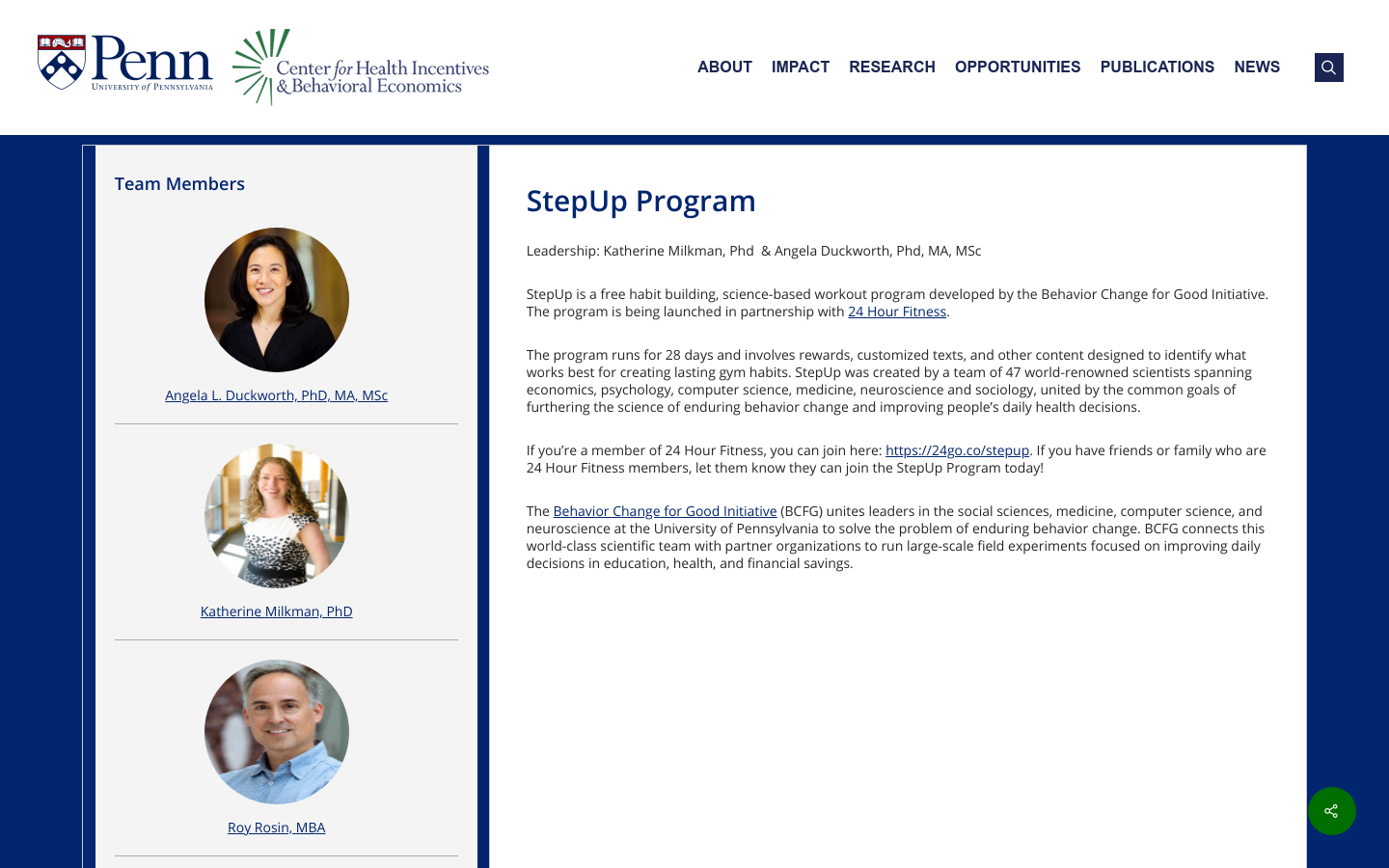
StepUp is a free habit building, science-based workout program developed by the Behavior Change for Good Initiative. The program is being launched in partnership with 24 Hour Fitness.
The Wharton School, University of Pennsylvania, Locust Walk, Philadelphia, PA, USA
The Busara Lab is now the largest behavioral science lab in the world with a panel of more than 133,000 participants across sites in India, Ethiopia, Kenya, Nigeria, and Uganda.