

Artificial Intelligence and the Future of Citizen Participation
The study shows how AI can make citizen participation more accessible, efficient and scalable.
Human-centred principles for the design and implementation of deliberative technologies
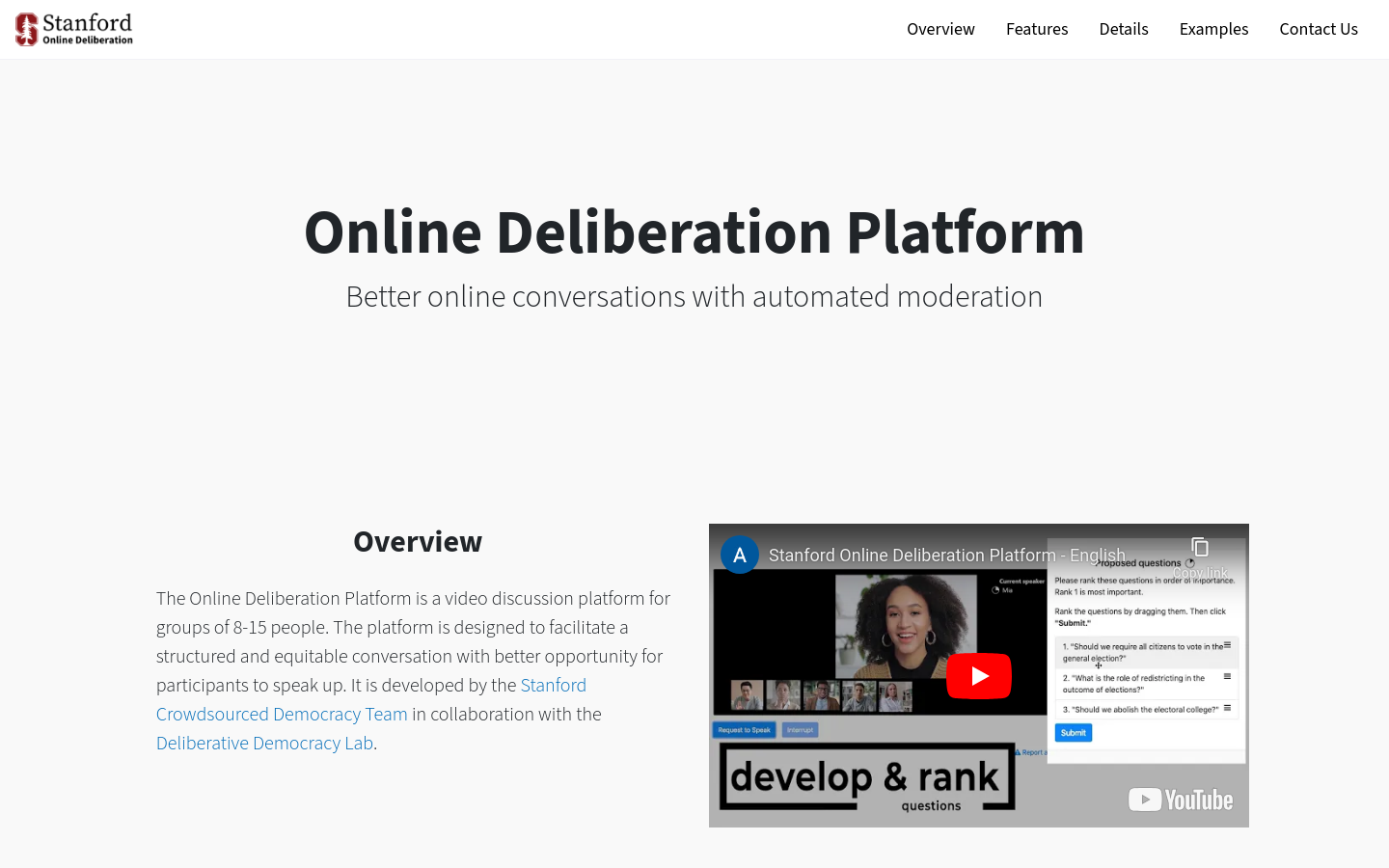
Our working definition of deliberative technologies is as follows: “Digital technologies that assist with and enhance deliberation, usually in a collaborative or decision-making setting” Note that delib-tech is a sub-category within the umbrella(s) of civic tech, democratic innovations and digital participation, that relates specifically to deliberation as the form of engagement, rather than voting or single one-directional inputs of feedback forms. Alongside the resurfacing of the 'delib-wave', Such deliberative technologies (‘delib-tech’) are increasingly using AI for a variety of functions, such as summarising statements from a wide range of diverse inputs, sentiment analysis, suggestions and recommendations, personal assistance through a chatbot and more, which offers great potential, yet there is an imperative for a guiding set of ethical principles that puts the human participant at its centre. How do we take advantage of the opportunities provided by digital technology to scale, speed up and increase the efficiency of deliberative processes, without sacrificing the affective experience of deliberation for human participants? SAAFE responds to the call for a need for practical principles that can be applied to delib-tech as we welcome more tech-enabled deliberations. Similar to the FairTrade label or BCorp badge, SAAFE signifies trust and integrity in tech-enabled deliberations for participants, stakeholders and the wider public. So, if you are planning to host or attend a deliberative forum using deliberative technology, get in touch to make sure it is SAAFE!

The study shows how AI can make citizen participation more accessible, efficient and scalable.

A working group of the Max Planck Institute for Political and Social Science. Informational Democracy publishes provocations, groundings, and reflections on topics such as collective intelligence, the role of AI in democratic systems, attention as a democratic resource, and the infrastructural transformation of the public sphere.

Democracy .one is a nonprofit "civic social platform" that turns people's civic opinions into structured Polls, Scores, and Ranks, clusters differently-worded expressions of the same position together, and aggregates them into a continuously-updating, comparable measure of public opinion it calls the "Civic Mirror."

Chattanooga has launched a pilot with Google's Jigsaw and Change.org called Civic Dialogue, that gathers residents' ideas on parks and transit, then uses "Sensemaking AI" to surface the proposals with the broadest support before a group of residents workshops them into policy.