Civic Tech Field Guide
Donate

https://stanforddeliberate.org/

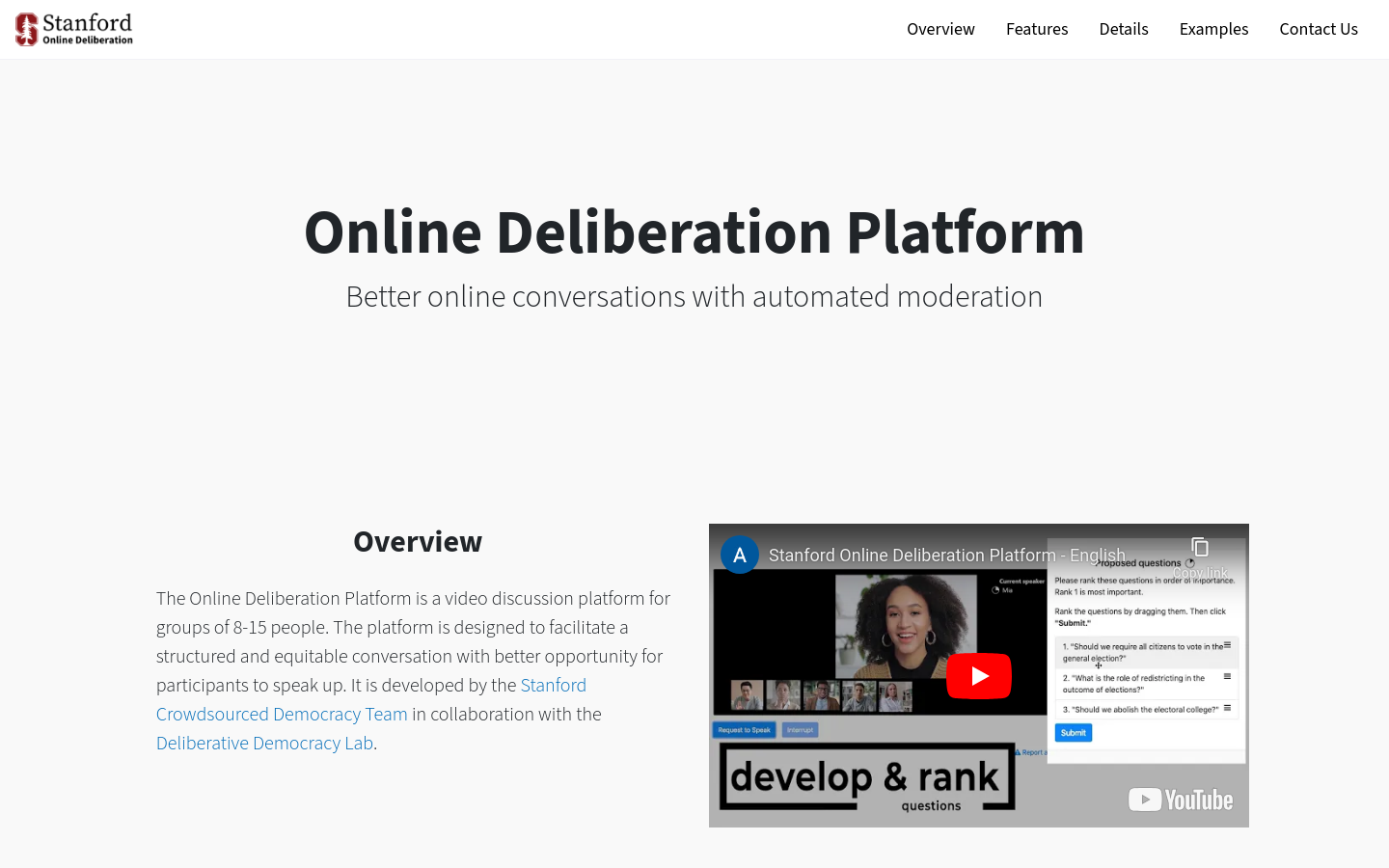
Stanford Online Deliberation Platform

The Online Deliberation Platform is a video discussion platform for groups of 8-15 people.

Active
450 Serra Mall, Stanford, CA 94305, USA
Open source: No (N/A)

The Stanford Platform for Online Deliberation is a collaboration between the Stanford’s Center for Deliberative Democracy and **[Crowdsourced Democracy Team](https://voxpopuli.stanford.edu/)** (https://voxpopuli.stanford.edu/). The platform is designed based on the Deliberative Polling methodology to massively scale deliberation to allow unlimited number of participants to deliberate in small groups together simultaneously. Among its many features is an automated moderator that allows participants to form speaking queues, discuss in small groups with timed agendas, and allow for equitable participation. The platform is easy to use without any downloads, includes abuse prevention, and real-time analytics. The platform has been used in several languages (including Japanese, Chinese, French) and for national Deliberative Polling events in Chile, Canada, and the United States. The platform is designed to facilitate a structured and equitable conversation with better opportunity for participants to speak up.

Funding details

Funded byDateAmount
Stanford Institute for Human-Centered Artificial Intelligence
Stanford Research Institute
David and Helen Gurley Brown Institute for Media Innovation

Evidence of this project's impact

The platform is under active development, and has recently been successfully deployed in Canada, Chile, Hong Kong, Japan, and at Stanford with 15 parallel groups each. We have supported deliberations with up to 1250 unique participants. We have facilitated about 800 room group sessions and created 8,000 rooms for the same. There are 10 rooms and 185 unique participants on average per session. So far, we have hosted over 11,500 hours of group discussion with close to 50,000 unique participants. (Source)2024-12

Resources

Related projects

Parent organization: Stanford Deliberative Democracy Lab

Founder(s)

James Fishkin

Project type
Tool or platform
Language(s)
Japanese, Chinese
Employees
8
Pricing
Not public
Used by
city halls, businesses, university faculty and students
Added
2024-11-22
Last modified
2026-07-12T16:45:52.000Z

Additional details

Tech stack
MySQL, WebRTC, Node.js, React
Integrates with
Perspective
Institutions using the platform
Used by city halls, businesses, university faculty and students, such as: Tokyo, Hong-Kong city halls, MetaVerse community forum, Stanford school students and faculty.
How AI is used
Because of its dynamics, the platform enables more equitable participation from all participants and nudges those who have not spoken much. When the system detects toxic behavior or a participant is reported, the automated moderator asks the group to validate the report and takes action accordingly. The convener can monitor the conversation live and record the session’s audio and interactions. The platform incorporates analytics, including transcripts and Natural Language Processing (NLP) tools, that help organizers understand in real-time whether a conversation is on topic and whether an agenda item has been fully discussed.
Number of end users
50,000
Number of integrations
2
Metrics of success
The platform is under active development, and has recently been successfully deployed in Canada, Chile, Hong Kong, Japan, and at Stanford with 15 parallel groups each. We have supported deliberations with up to 1250 unique participants. We have facilitated about 800 room group sessions and created 8,000 rooms for the same. There are 10 rooms and 185 unique participants on average per session. So far, we have hosted over 11,500 hours of group discussion with close to 50,000 unique participants.
Geographic focus
Japan (Nihon or Nippon) 🇯🇵, Chile 🇨🇱, Canada 🇨🇦, Hong Kong, United States of America 🇺🇸
Geographic focus — country
Japan (Nihon or Nippon) 🇯🇵, Chile 🇨🇱, Canada 🇨🇦, China (Zhong Guo) 🇨🇳, United States of America 🇺🇸
Pricing
Not public
Demo
No
Documentation & learning
Not publicly available
Support resources
Not publicly available
Accessibility certification
Unclear

More in Academia