Shared infrastructure for the access to justice sector — so legal aid organizations, courts, and technology partners can build better AI together, instead of reinventing the wheel alone.
The Legal Help Commons organizes shared resources around three complementary pillars — discovery, implementation, and community. An R&D discovery platform cataloging AI projects, a formal task taxonomy, datasets, benchmarks, guides, and orientation resources for anyone entering the justice AI landscape. Reference architectures, implementation playbooks, proven code and classifiers, RFP templates, cost models, evaluation rubrics, API connections, and design pattern libraries. Working groups around specific workflows, public interest tech courses and groups, justice professional networks, and peer-learning programs connecting those building, stewarding, evaluating, and scaling new solutions.
Journal of Deliberative Democracy (previously the Journal of Public Deliberation)
The Journal of Deliberative Democracy (formerly the Journal of Public Deliberation) is an open access journal publishing articles that shape the course of scholarship on deliberative democracy.
We aim to reframe the conversation about technology and labor towards issues of power, inequality, and social justice, and incorporate themes of feminism, anti-racism, and transnationalism.
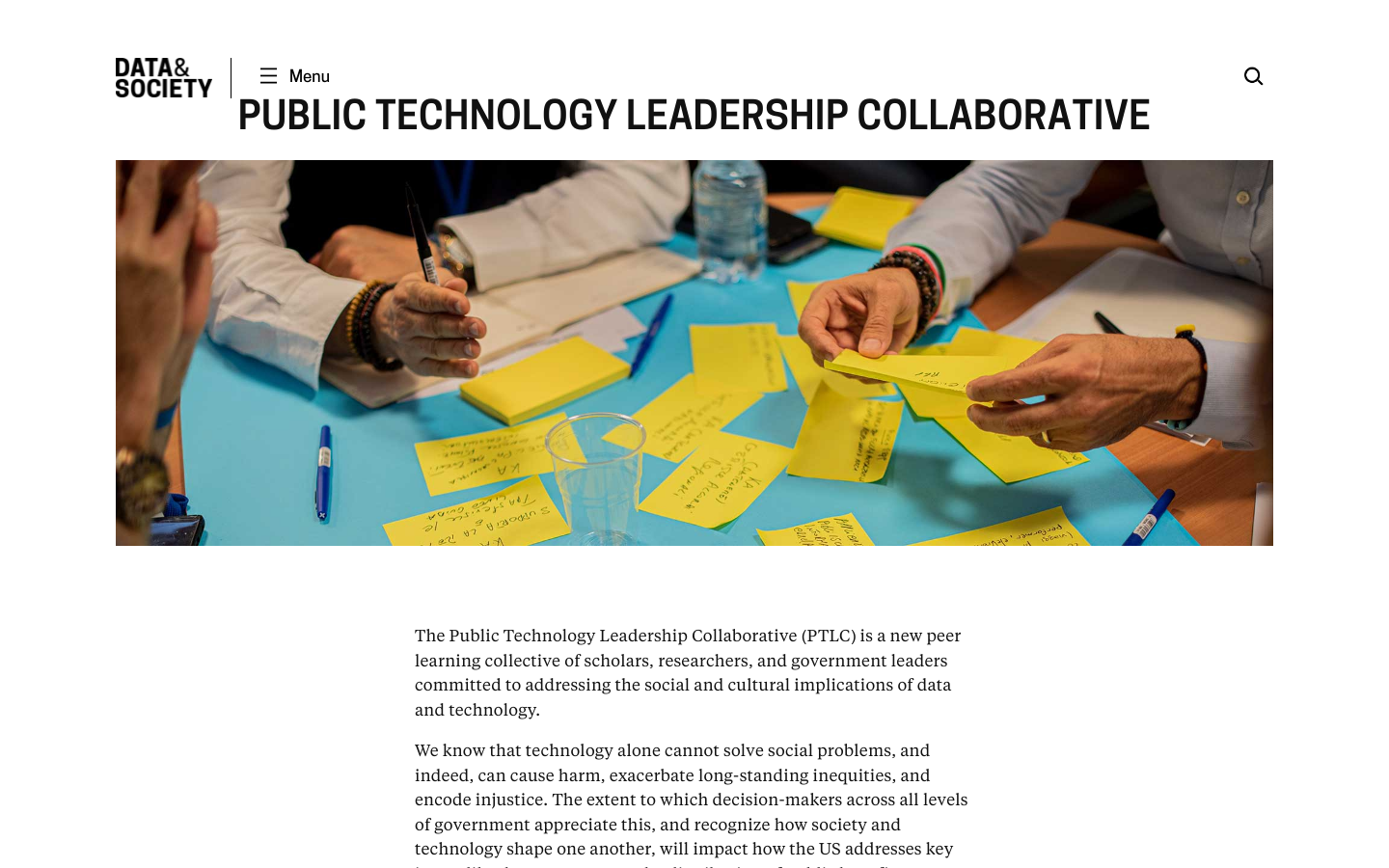
The Public Technology Leadership Collaborative (PTLC) is a new peer learning collective of scholars, researchers, and government leaders committed to addressing the social and cultural implications of data and technology.
Data & Society Research Institute, West 20th Street, New York, NY, USA