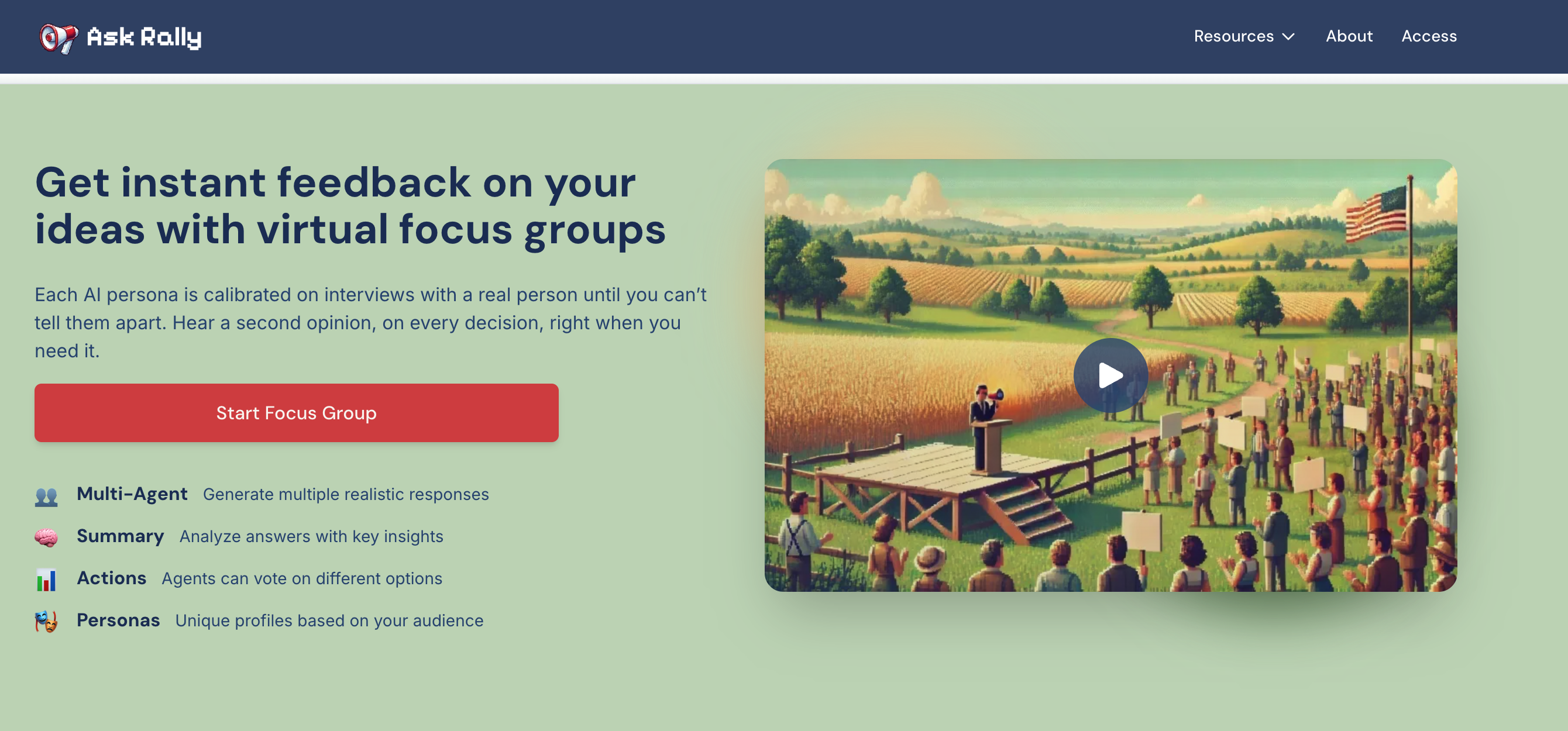
Love it or hate it, more projects are building synthetic versions of the public. They're used to consult (a proxy for) public opinion in real-time for a fraction of the cost.
As Matt Stempeck wrote in People Powered's Guide to Digital Participation Platforms (2025):
"AI's ability to synthetically represent complex systems has inspired research to use it to create synthetic agents as proxies for engaging actual people. Google Deepmind's AI lab teamed up with Stanford and other researchers to create AI agents that, the authors claim, can reliably predict what the people themselves reported after 2 hours of upfront training. The accuracy of the synthetic person-agents suffered in other situations, such as in economics games.
Future research will likely improve upon these results, but the entire direction of this work represents an existential decision point for participatory democracy. Do we want to cede our involvement to AI proxies that may (or may not) represent what we would say or do in a given situation? Even if they proved accurate, what do we lose from people not personally engaging with one another, within communities and between the elected and the governed? If decisionmakers can only consult AI avatars, will it be possible to heed the thoughts and lived experiences expressed by AI with the same care that comes when speaking with human constituents?
Should we celebrate a near future where "politicians can talk to these avatars and get to know members of the public in a really granular way"? What do we lose when public officials can skip some of the few remaining opportunities for engaging their constituents, and vice versa? Is it another dangerous step towards disenfranchised citizenry?
Much of the value in democratic systems lies in the interactions we have with one another. Participation and engagement with political systems drive benefits well beyond the specifics of a given policy outcome. AI increasingly tempts us to automate ourselves out of our involvement with an ever-expanding range of activities, with all of the associated promises and risks discussed in this report. But is automating away the active role of the people in democracy a step too far?"