
Governance of Emerging Technology and Tech Innovations for Next-Gen Governance (GETTING-Plurality)
A multi-disciplinary research network linking philosophers, social scientists, computer scientists, legal scholars, and technologists.
This study addresses one of the most frequently cited explanations for PB’s instability: changes in the ruling party.
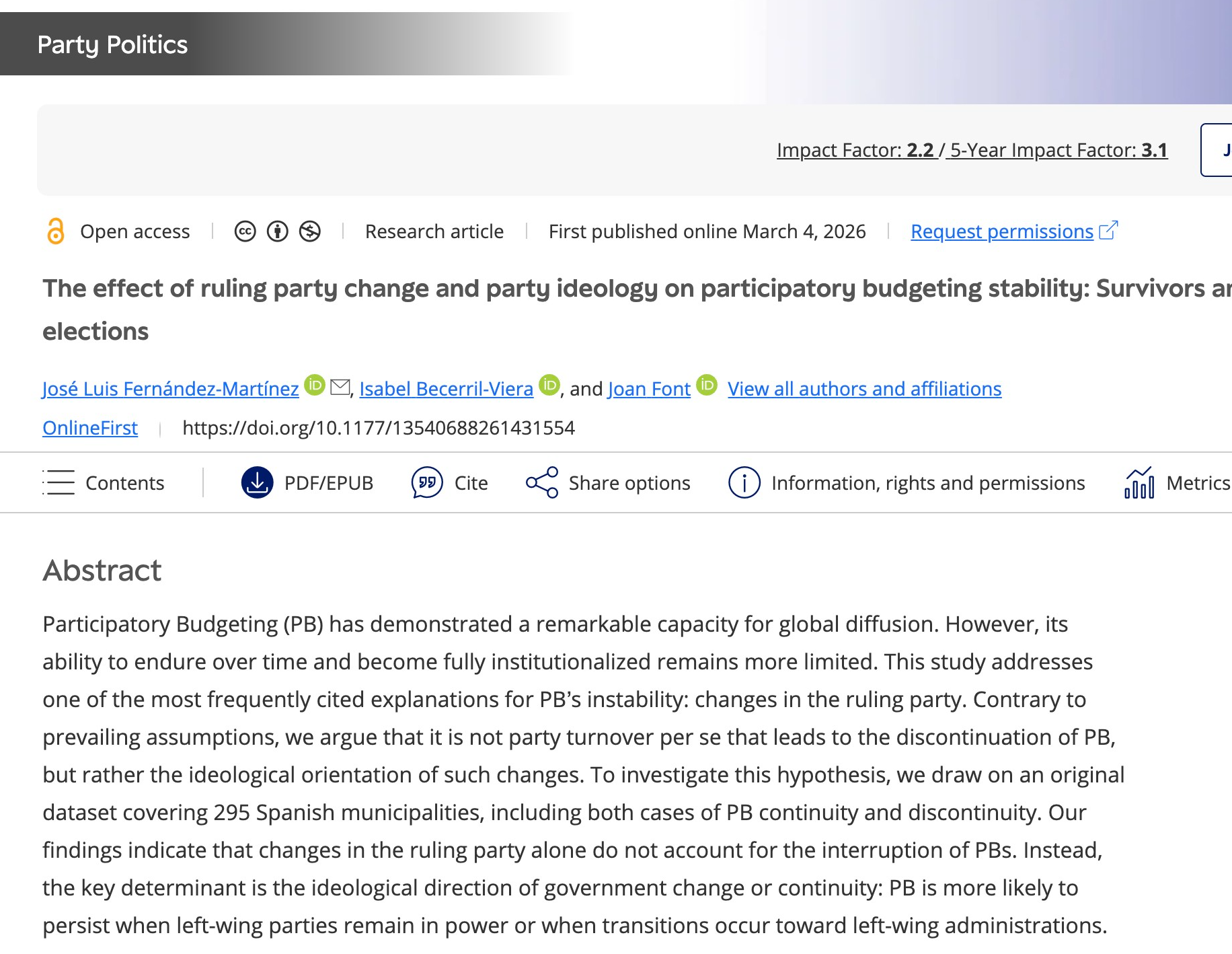
by José Luis Fernández-Martínez, Isabel Becerril-Viera, Joan Font Participatory Budgeting (PB) has demonstrated a remarkable capacity for global diffusion. However, its ability to endure over time and become fully institutionalized remains more limited. This study addresses one of the most frequently cited explanations for PB’s instability: changes in the ruling party. Contrary to prevailing assumptions, we argue that it is not party turnover per se that leads to the discontinuation of PB, but rather the ideological orientation of such changes. To investigate this hypothesis, we draw on an original dataset covering 295 Spanish municipalities, including both cases of PB continuity and discontinuity. Our findings indicate that changes in the ruling party alone do not account for the interruption of PBs. Instead, the key determinant is the ideological direction of government change or continuity: PB is more likely to persist when left-wing parties remain in power or when transitions occur toward left-wing administrations.

A multi-disciplinary research network linking philosophers, social scientists, computer scientists, legal scholars, and technologists.

Offers world-class online courses that empower you to think differently, learn collaboratively and join a global community of learners and doers with a burning desire to change the world.

This is the online learning portal of the Community Solutions Network

A collection of the many projects the Prototype Fund has supported, including many civic tech and open data projects.