
Machine Learning and the Rule of Law
Predictive judicial analytics holds the promise of increasing the fairness of law.
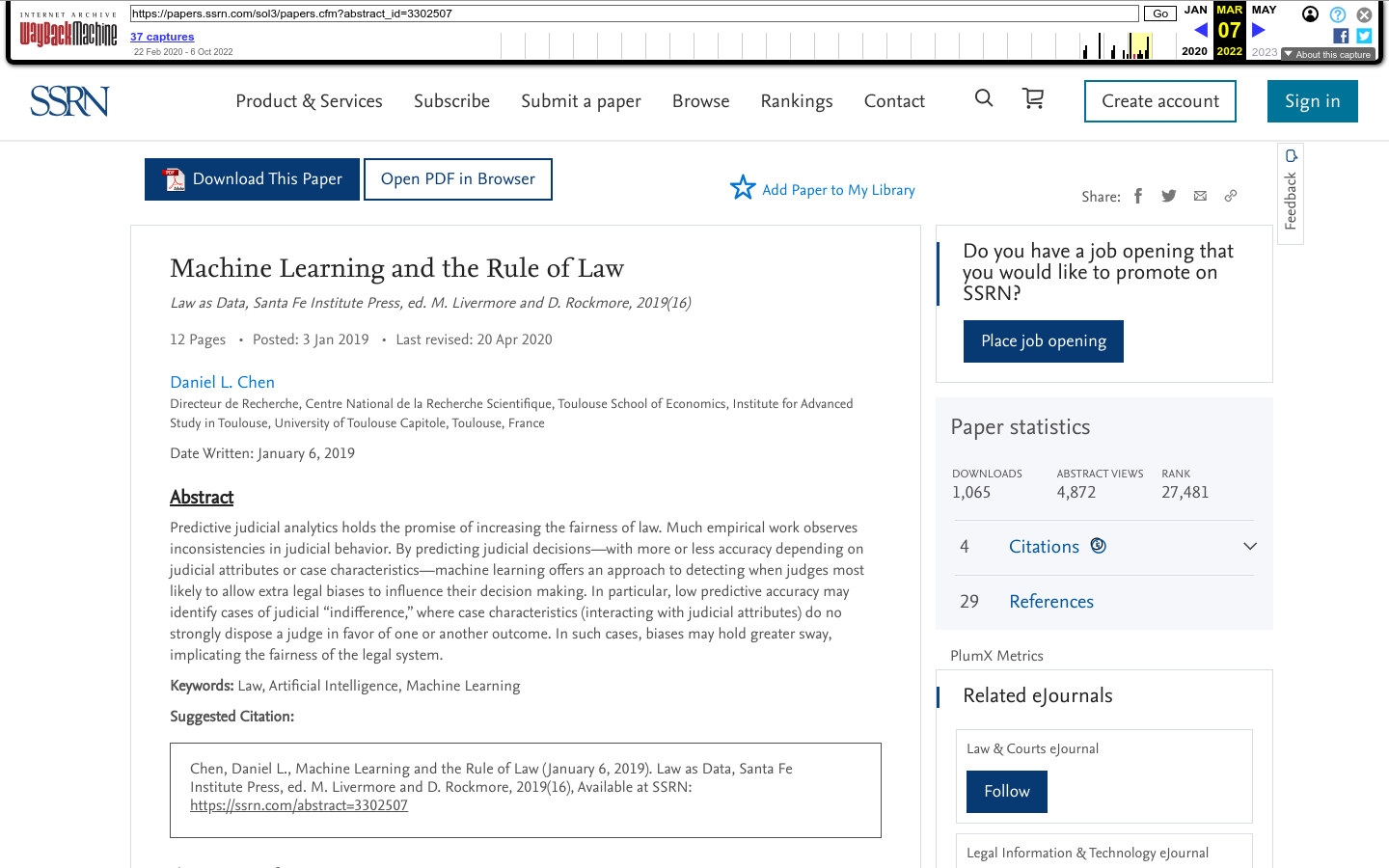
Predictive judicial analytics holds the promise of increasing the fairness of law. Much empirical work observes inconsistencies in judicial behavior. By predicting judicial decisions—with more or less accuracy depending on judicial attributes or case characteristics—machine learning offers an approach to detecting when judges most likely to allow extra legal biases to influence their decision making. In particular, low predictive accuracy may identify cases of judicial "indifference," where case characteristics (interacting with judicial attributes) do no strongly dispose a judge in favor of one or another outcome. In such cases, biases may hold greater sway, implicating the fairness of the legal system.
Resources
- Project type
- Document
- Language(s)
- English
- Tech stack
- BuiltWith report →
- Categories
- Artificial Intelligence (AI), Emerging tech, Machine learning, Open justice, Peer-reviewed research
- Tags
- research
- Added
- 2021-06-22
- Last modified
- 2025-11-12T22:26:30.000Z
Additional details
- Formats
- research
- Number of integrations
- 0