Civic Tech Field Guide
Submit Project

https://orchestrated.dev

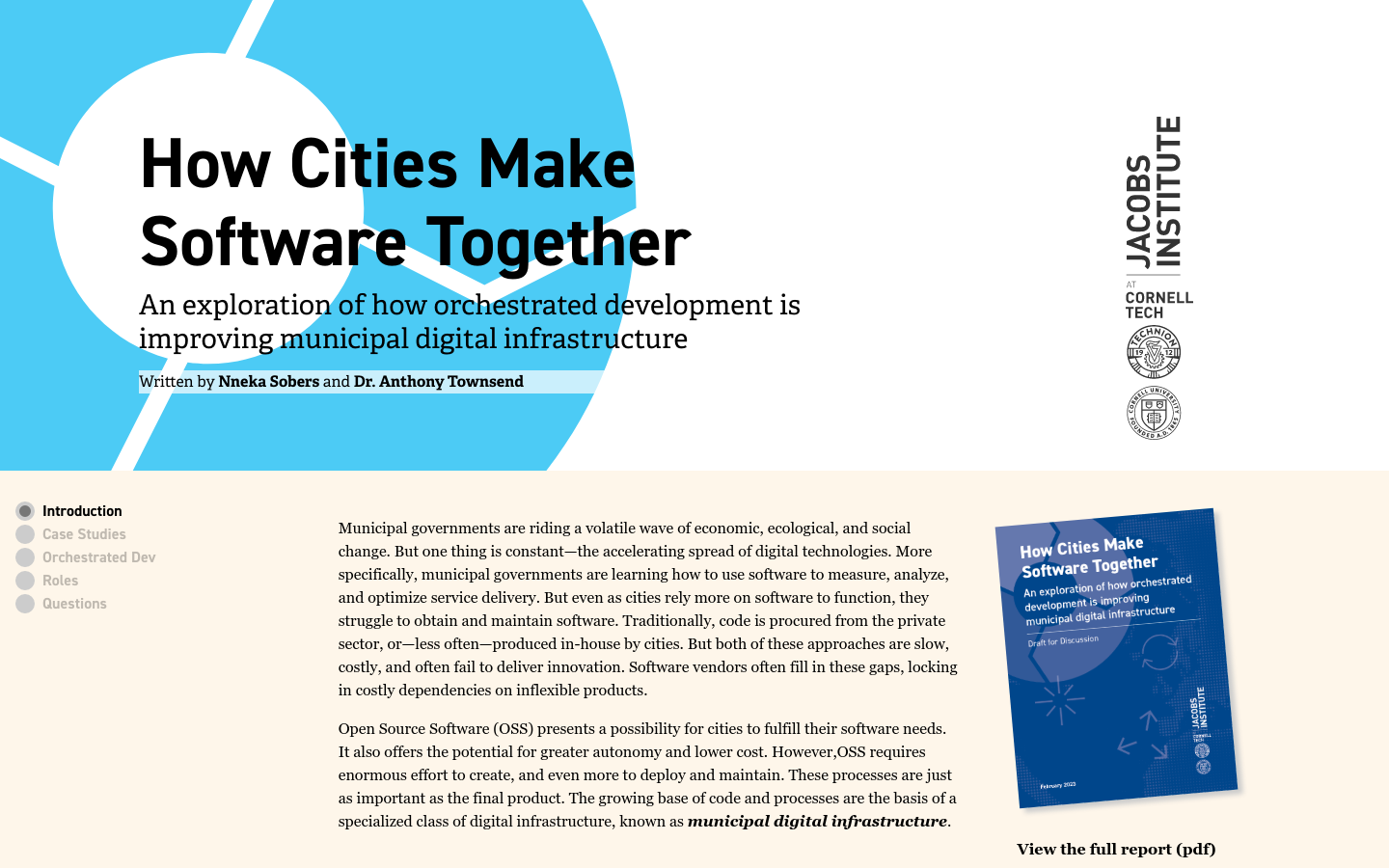
How Cities Make Software Together

A report by Written by Nneka Sobers and Dr. Anthony Townsend.

Active
Since 2023
Cornell Tech

Municipal governments are riding a volatile wave of economic, ecological, and social change. But one thing is constant—the accelerating spread of digital technologies. More specifically, municipal governments are learning how to use software to measure, analyze, and optimize service delivery. But even as cities rely more on software to function, they struggle to obtain and maintain software. Traditionally, code is procured from the private sector, or—less often—produced in-house by cities. But both of these approaches are slow, costly, and often fail to deliver innovation. Software vendors often fill in these gaps, locking in costly dependencies on inflexible products. Open Source Software (OSS) presents a possibility for cities to fulfill their software needs. It also offers the potential for greater autonomy and lower cost. However, OSS requires enormous effort to create, and even more to deploy and maintain. These processes are just as important as the final product. The growing base of code and processes are the basis of a specialized class of digital infrastructure, known as municipal digital infrastructure.

Related projects

Parent organization: Jacobs Urban Tech Hub at Cornell Tech

Project type
Document
Founded
2023
Language(s)
English
Categories
Govtech, Reports
Added
2023-03-31
Last modified
2026-07-12T16:44:35.000Z

Additional details

Formats
reports, case studies
Number of integrations
0

More in Govtech

Nigeria's Reform Tracker, Knowledge Repository & NSPSR Dashboard

Nigeria's Bureau of Public Service Reforms has launched three linked digital tools: a reform tracker, a knowledge repository, and a real-time dashboard, to monitor, document, and measure public-service reforms across federal ministries and agencies.

Lagos
2026

Viran

Viran is a Finnish commercial AI service that helps private companies sell to the public sector by monitoring public tenders, giving go/no-go recommendations, and drafting scoring-optimized bids, typically on a fixed-fee or success-fee basis.

2026